Tuesday, August 31, 2010

I'm Floored.


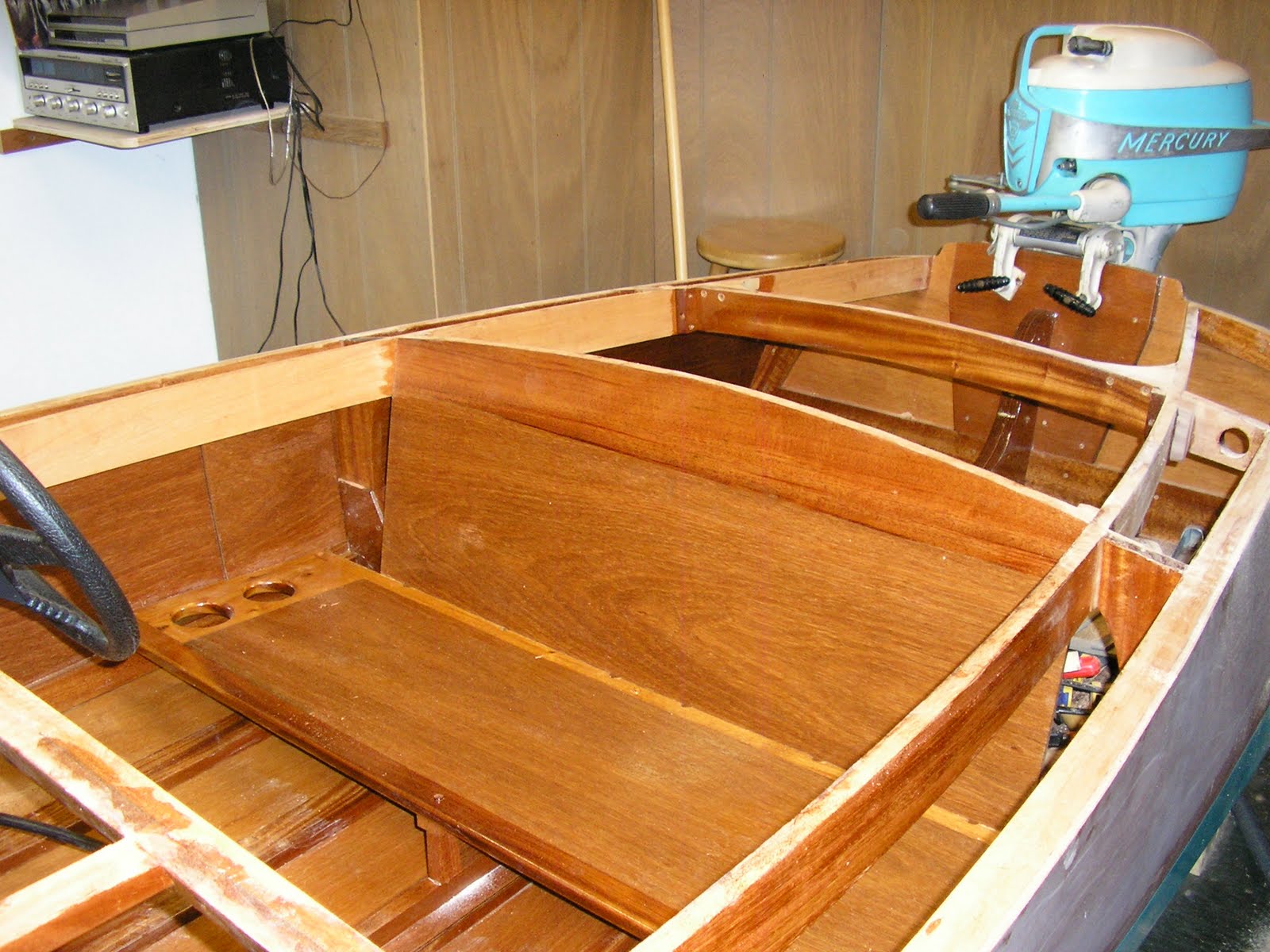
After a bit of consulting with my aesthetic director, she decided the best looking flooring option was additional battens added between the existing ones. A piece of plywood added over the battens was not attractive and not adding battens made it unclear to anyone that would get in the boat whether to step on a batten or on the hull plywood.

The 6 additional battens were cut and edges routered on the top side. Then with some pencil mark-ups on fitting to the floor, a stationary belt sander made quick work of getting them to fit to the floor. The creative use of clamps as spreaders and some other contraptions allowed the battens to be pushed tight to the floor while the thickened epoxy cured. I could only do 2 or 3 at a time due to limited number of clamps that could be made into spreaders. The floor looks a bit like flattened organ foot pedals without the black keys.

Saturday, August 28, 2010

Throttle/Shift Controller Arrives - Finally!


Back in early July after advertising on the Antique Outboard Motor Club website that I needed a controller, I got a response from a guy in New Jersey that he had a Green Quicksilver manual two lever controller with cables that would be the right length for a Squirt and the appropriate vintage for my motor. He actually had it on a Squirt some years back. We agreed on a price, I sent a check and started waiting for the package to arrive. I made some follow-up calls to him and he said he was trying to track down the package with the post office. After several weeks and a few interim calls, I called ready to ask for a refund and he said the post office never did find it in their system but over the weekend a soggy box with all the addresses blurred arrived back at his shop. It was my wayward controller. He repackaged it and sent it UPS this time and gave me the tracking number. I tracked it on the UPS website right to my door and it only took 3 days.

It's all there and the cables hook up to the engine as it's supposed to. After playing around with various potential locations, it seems that the best location is between the carling and the shear just aft of the dash. If mounted low on the side it has to be on the floor for the levers to clear and it's not a comfortable place while seated in the boat. Inboard of the carling, the cables are exposed and its right where my knee wants to be. This means the decking will need a cutout for the levers to protrude through. Other Squirt builders have mounted it there and now I see why.


The cables have the necessary connectors for hook-up to the motor and are about 9' long. They may be a bit long but it all seems to work. He included an extra set of cables that are about 11' long just in case.

Monday, August 23, 2010

Hang on a Minute - I Gotta' Drain It

There comes a time when the pressure builds and you just gotta' do something that you have put off too long....like putting drain plugs in a boat. The thought of drilling big holes in the transom scared the heck out of me, but I couldn't put it off any longer. After contemplating and procrastinating, I reviewed the cross-section of the transom to determine the lowest point in the transom I could drill a perpendicular hole and not breach the plywood bottom planking. I also looked at photo's on this blog to see where I had located screws to hold on the bottom planking near the keel as I did not want to drill into one.


I then decided to bore a guide hole in a 2x6 and clamp it to the inside of the transom and another scrap board to the outside to prevent break-out when I drilled through. The first hole when well, and then I moved to the other side of the keel and located the hole and drilled another pilot hole in the 2x6 in the right location. The pictures show the second hole about to be drilled.


I tried to insert the drain sleeve into the hole from the outside, but it was too snug. I used a rotary drum sander to open it up slightly until the sleeve would ease in. Then I marked the sleeve with a Sharpie to leave it about 1/8" long. I removed the sleeve and a tubing cutter was used to cut it off. The sleeves were filed slightly around the outside to provide some fine scratches to ensure a good bite. Epoxy was mixed and coated the inside of the holes. Then some high density #404 filler added to thicken it up and smeared into the holes. The sleeves were inserted fully from the outside and I rigged up a bolt with large washers in each one to make sure they were held firmly in the hole while the epoxy cured.

The next day, I used a small ball peen hammer and slowly peened the brass sleeve over to provide a flange on the inside of the boat. The drain plugs fit in nicely and it's all good.


Wednesday, August 18, 2010

Hatching a Plan

At a car and boat show in Franklin, MI there was a "Curley Craft" wood boat with the type of hatch I am building on my boat. Incidently, "Curley Craft" boats were produced at Northwestern Boat Co. on 10 Mile at Evergreen. The place is still there selling boats, outboards etc. and providing marine services, but they no longer build boats.
A three sided frame was built and added into the space to create the hatch surround. The rear beam was doubled up to provide enough surface for the plywood decking.


Then I traced the curvature of the rear beam and made a single hatch assembly that will later be cut into two hatches after the decking plywood is installed.

The hatch is mounted into position using some shims, duct tape on top to prevent drips of epoxy from gluing them in) to equally space it in the hole. The plan is that once the decking is in place, holes will be drilled up from the bottom at the corners to define the margins and then sawcut out the hatch. The side margins will be cut first and the hinges installed (while its perfectly aligned) and then the remainder cut out. Then the hinges can be removed and the hatch cut into two pieces and finished out. Stainless steel banding will cover all the margins.

Tuesday, July 20, 2010

Decking Structure


After flipping the boat, it was time to figure out what to do next. The carlings had to go in as they provide the structure for between the main deck beam and the transom. After planing some honduras mohogany down to 5/8" thick, it did not want to bend into position so I got out the soaking pipe and rigged it into the stairwell again and soaked the wood for a day. I rigged up some extensions so the carlings could be pulled into the proper curve above the boat, let dry, and then marked and trimmed to fit. It required some creeping up on compound angle cuts until the angles and length were slowly tuned in.
A mid-front deck beam was added per the plans and then I decided to create an auxiliary dash beam to support the deck strongback (longitudinal middle support) and deck battens so the dash could be made removable while designing and fitting in place. The dash is at a 20 degree angle and I'm using Teleflex steering "The Rack" mounted upside down so the cable routes inward and loops under the deck following Squirt builders Bill & Linda Whitney in Glen-L's WebLetter 65.
I did a lot of playing around with mocked up seat boards after getting the steering wheel in place to determine seat fore-aft location. Then after a lot of circular thinking and planning, eventually built the seat bottom and put in a couple of holes for holding drinks or whatever. With the seat bottom in place I can finalize the seat back angle and mid deck beam.

In order to use a scrap piece of 1/4" plywood for the seat, I rabbeted the seat bottom frames and deck beam to utilize an 8' long strip of plywood only 12 1/2" wide. I used a forstner bit to bore some half round drain holes at the junction of the seat bottom and seat back to allow any water that gets on the seat to drain through. I plan on having upholstered seat cushions at some point, but wanted a functional and structural seat in place without the cushions.

With the motor mounted I figured out where to place the rear most beam while allowing a 6 gallon gas tank to be loaded in between the beam and transom and slid into the corner. It's a bit tricky due to the transom knee, but can be done. I'm planning to build a two door hatch in the deck that opens from the center and hinges to each side. The thought is to allow the center of the boat to open up without the hatch lids being in the way and permit easier access to the outboard since it is a manual start. I also am planning the hatch to allow loading a 6 gallon tank as once all the remote connections to the outboard are mounted, I'm not sure if the back will still be easily accessed. I added the corner radius reinforcements to the opening and added short beam extensions to tie the rear beam and carling to the shear. With these bits in place, the improvement in rigidity of the structure is amazing. I'm working on the corner radius pieces at the dash and then it will be time to tackle the hatches.

Tuesday, June 8, 2010

Flip It...Flip it Good

The time for the flip finally arrived! To have some music to flip by, listen to Devo "Whip It" and think "Flip It". Here are the lyrics I put together for it:

Crack that flip
Give your boat a slip
Step on a tack
Break your flippin' back
When your project comes along
You must flip it
Before the dream sits out to long
You must flip it
With someone very strong
You must flip it
Now flip it
Into shape
Top side up
Get straight
Go forward
Move ahead
Try to protect it
Its not too late
To flip it
Flip it good
When the right time comes around
You must flip it
You will never live it down
Unless you flip it
No one gets away
Until they flip it
I say flip it
Flip it good
I say flip it
Flip it good
(Repeat from beginning)


The boat was readied for flipping by drilling 1" holes in the box that bow sat on and inserting a pipe clamp with a turnbuckle inserted around the pipe to provide a pivot point. I then rigged that up to a come-along to lift the bow. The plan was to rotate the boat like on a spit. The rear of the boat was place on a salvaged oak bannister rail and jack stands. A rope was also suspended from the ceiling joists as support during the flip.
The forms were removed from underneath the boat, the cradle put in place and with Ted and Roger doing the heavy lifting, we began the flip.


The oak support was removed and the rope and cradle used to provide a rest at half flip.
The boat now rests on the cradle and a new phase of construction is about to begin!

Friday, May 28, 2010

Mark 25 Remote Shift Linkage

I was reviewing my blog yesterday and noticed that I had a comment posted back in April from a reader wanting more detail on my Mark 25 shift linkage as his was purchased in pieces. Here are a couple of pictures and I hope it helps. I put some carpet foam that happened to be nearby under the linkage so the details would not be obscured by background stuff. There is a anchor bracket that is held by the nut holding on the steering bail and the pivot bracket is as shown. I do not yet have a remote shift/throttle control and cables yet, so I'm in the hunt for that stuff. I took a quick look at my pre-1965 Mercury service manual and it shows pictures and instructions for cable hook-up when I get to that point. I found the parts manual on line at the Western New York chapter of the AOMCI website. http://pub9.bravenet.com/photocenter/album.php?usernum=737212788&album=49514#bn-photocenter-1-1-737212788/49514/1/116515/